
Westmoreland County Court Records After a Jail Arrest
The court-record path after a Westmoreland County jail arrest runs through Pennsylvania's Unified Judicial System, the magisterial district courts, the Court of Common Pleas, and the Westmoreland County Clerk of Courts. Westmoreland County Prison confirms active custody, but the official roster does not show charges, bail amounts, court dates, docket numbers, or dispositions.
After an arrest and booking, the case record can begin with police paperwork, a criminal complaint, preliminary arraignment, bail decision, and early magisterial district court events. The Westmoreland County District Attorney prosecutes criminal cases and may approve, amend, reduce, withdraw, or add charges as the case moves. For the custody side, use jail inmate records; for booking-photo questions, use jail mugshots.
How to Find Westmoreland County Court Records After an Arrest
Pennsylvania UJS Case Search is the public starting point for court records after a jail arrest. It is free for public docket searches and does not require a login. Recent entries may lag, and juvenile, expunged, limited-access, sealed, or otherwise restricted records may not appear. The Clerk of Courts remains the local office for certified copies, older access questions, and Common Pleas criminal files not fully answered online.
- Search the prison roster first to confirm custody and copy the exact name, DOB, booking number, and commitment date.
- Open UJS Case Search and search by Participant Name with Westmoreland County selected when filters are available.
- Try OTN, complaint number, incident number, or docket number if a name search is too broad or too new.
- Open both Magisterial District Judge and Court of Common Pleas dockets when both appear.
- Review charges, grading, statute sections, bail entries, events, warrants, holds, and dispositions.
- Contact the Clerk of Courts for certified copies or files that are not available from the public portal.
The Pennsylvania UJS Case Search screen is the statewide portal used for docket searches after a Westmoreland County arrest.
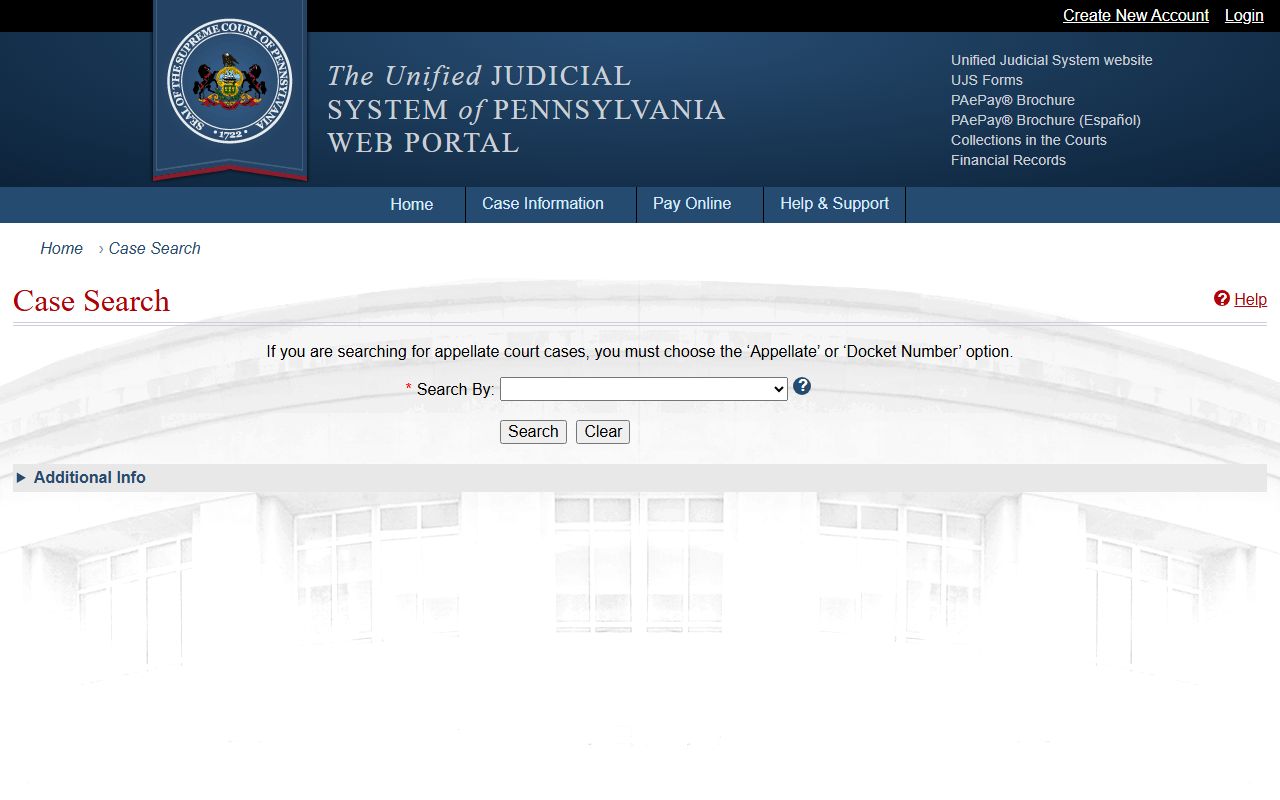
Use the court portal for charges and case events, not the jail roster, because the Westmoreland County Prison roster is a custody index only.
UJS Search Fields for Court Records After Arrest
UJS offers several search paths. Participant Name is usually the easiest public route when only a booking name is known, but docket number, OTN, complaint number, incident number, and date-filed searches can be more precise when those identifiers are available.
| Field Label | Type | Required | Options / Format Notes |
|---|---|---|---|
| Search By | Dropdown | Yes | Includes Participant Name, Docket Number, OTN, Complaint Number, Incident Number, Citation Number, Date Filed, Calendar Event, Attorney, Organization, SID, and other search paths. |
| Advanced Search | Checkbox | No | Reveals additional filters for many search types, including county limits where available. |
| Docket Number | Text | Conditional | Westmoreland County Common Pleas criminal dockets use county code 65 in CP-65-CR format. |
| Date Filed Start / End | Date | Conditional | Used for filing-date range searches when supported by the selected search path. |
| County | Dropdown | Conditional | Select Westmoreland to avoid statewide name matches. |
| Scheduled Events Only | Checkbox | No | Limits results to cases with future events. |
How Charges Get Filed After an Arrest: Complaint, Information, and Indictment
The charge record begins when the allegation moves into court paperwork. A criminal complaint often appears at the magisterial district court stage. If the case proceeds, the District Attorney controls prosecution decisions and can move charges into Common Pleas through the appropriate filing. The exact document path depends on the offense, procedure, and court level.
| Complaint | Information | Indictment | |
|---|---|---|---|
| Filed By | Police or prosecutor depending on stage | Prosecutor | Grand jury process where used |
| Common For | Initial criminal allegations and MDJ case start | Cases proceeding in Common Pleas | Serious or special matters when grand jury procedure applies |
| What It Starts | Early docket activity, arraignment, bail, and preliminary hearing path | Formal prosecution in Common Pleas | Court case based on grand jury action |
| Why It Can Change | Charges can be held, dismissed, amended, or waived at early stages | DA may amend, reduce, add, or withdraw counts | Later court orders or plea/trial outcomes may alter the case posture |
Charge Status in Court Records After a Jail Arrest
Charges are not fixed just because a person was arrested. A booking can be based on an arrest charge, warrant, probation or parole hold, sentence, detainer, or another commitment. Court records after a jail arrest may show charges that are pending, amended, reduced, withdrawn, dismissed, or resolved by plea, trial, or sentence. The roster's commitment record may stay the same while the docket changes.
| Status | What It Means |
|---|---|
| Pending | The charge remains active and has not reached a final disposition. |
| Held for court | The case or count has moved past the preliminary stage toward Common Pleas proceedings. |
| Amended / Reduced | The filed charge changed in wording, grade, statute, or severity. |
| Withdrawn | The prosecution or charging authority ended that count before final conviction. |
| Dismissed | The court dismissed the count or case at a procedural stage or by order. |
| Nolle Prosequi | The prosecutor formally declined to continue that count or prosecution. |
| Guilty / Convicted | A plea or verdict resolved the charge as a conviction. |
Bond and Release After an Arrest
Bail is a court function in Pennsylvania. Westmoreland County Prison holds the person under the court's order; it does not set the bail amount. Use UJS Case Search for bail entries, docket status, detainers, and scheduled events. If the docket directs eligible online payment, use PAePay Bail. A detainer, hold for another jurisdiction, state parole issue, federal hold, or immigration matter can prevent release even after a Westmoreland County bail payment.
The official PAePay Bail portal is the statewide online payment path when a case is eligible.
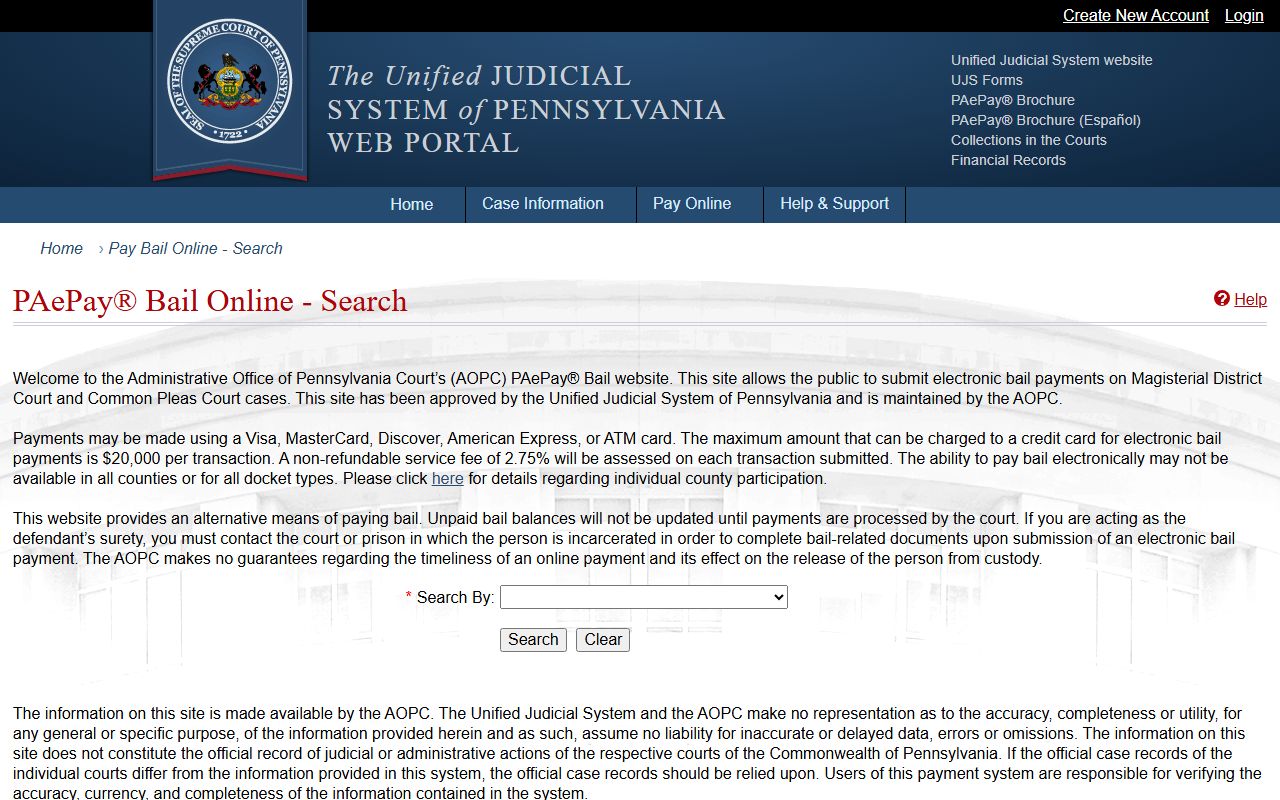
If the case is not eligible online, follow the instructions from the court, Clerk of Courts, or magisterial district court listed on the docket.
| Bail Type | How It Works |
|---|---|
| Monetary / cash bail | Payment is required through the court-approved channel before release conditions can be satisfied. |
| Surety bail | A surety or bail agent may be involved where allowed and ordered by the court. |
| Unsecured bail | No upfront deposit is required, but money may be owed if conditions are violated. |
| ROR / nonmonetary | Release depends on a promise to appear or nonfinancial conditions ordered by the court. |
| No-bail or hold | Release is unavailable or blocked because of the case, sentence, detainer, warrant, or another agency hold. |
Warrants That Lead to an Arrest
Westmoreland County warrant records and jail custody records are separate. A bench warrant, arrest warrant, probation or parole detainer, fugitive warrant, out-of-county hold, or federal hold can lead to a prison commitment after the person is arrested or surrenders. Before commitment, the person may not appear on the prison roster at all.
Use the county warrant-search and sheriff warrant pages for local warrant information, then check UJS for docket events and the roster only after arrest. The county Most Wanted page can show public-safety information, but it is not comprehensive and is not a jail booking archive. Anyone who may have an active warrant should contact counsel or the issuing court rather than treating a website search as legal clearance.
Charges vs. Convictions
A court record after an arrest can show accusations before guilt has been decided. That distinction is essential for Westmoreland County records because the jail roster confirms custody and the court docket lists case activity, but neither should be summarized as a conviction unless the docket actually shows a guilty plea, verdict, or other conviction disposition.
| Charge | Conviction | |
|---|---|---|
| Stage | Allegation filed in court after arrest or complaint activity | Final guilt finding through plea, verdict, or qualifying disposition |
| Burden / posture | Based on probable cause and prosecution decisions at early stages | Resolved under the criminal burden and court process |
| Can change? | Yes, charges may be amended, reduced, withdrawn, or dismissed | Changes require later court action, appeal, post-sentence relief, expungement, or limited access where available |
| Public use caution | Do not treat as proof of guilt | Still verify final disposition with the court record |
Sealed vs. Expunged Arrest Records
Pennsylvania public access is shaped by the Right-to-Know Law, court-record rules, CHRIA, and expungement law. UJS warns that juvenile, expunged, limited-access, and other restricted records may not display. Expungement under 18 Pa.C.S. 9182 addresses eligible criminal-history record information, while limited access or sealing affects public visibility without necessarily erasing every government trace.
| Sealed / Limited Access | Expunged | |
|---|---|---|
| Public visibility | Hidden or restricted from ordinary public access where the law or order applies. | Removed or treated as unavailable under the expungement order and applicable law. |
| Law enforcement access | May remain available to authorized agencies or courts in limited circumstances. | Very limited, depending on the order, record type, and statutory exception. |
| Eligibility | Depends on Pennsylvania limited-access rules, disposition, offense type, and court action. | Depends on 18 Pa.C.S. 9182, case outcome, age, time, and other statutory criteria. |
| Practical step | Check the docket and court order, then contact the Clerk of Courts or counsel. | Use the court and Pennsylvania State Police criminal-history process where required. |
Background Check Considerations
UJS public dockets and jail rosters are not substitutes for a Pennsylvania State Police PATCH criminal-history background check, and they should not be used for employment, housing, credit, insurance, tenant screening, or other regulated consumer-reporting decisions unless the process complies with all applicable law. A roster hit may only show that a person was committed to the prison. A court docket may show allegations, not final guilt.
Important: Public lookup pages are not FCRA consumer reports and should not be used for FCRA-covered decisions.
Restricted Court Records After an Arrest in Westmoreland County
Some records are withheld or redacted because of juvenile status, sealing, expungement, limited access, victim protections, criminal-investigation exemptions, safety concerns, privacy rules, or court orders. The Westmoreland County Regional Youth Services Center is not a public adult roster source, and juvenile detention matters should be handled through juvenile court, counsel, parents or guardians, placing agencies, or authorized officials.
The official Westmoreland County Clerk of Courts page is the local court-record access point for criminal files and certified-copy questions.
Use the Clerk of Courts when online docket information is incomplete, older, restricted in public display, or needed in certified form.